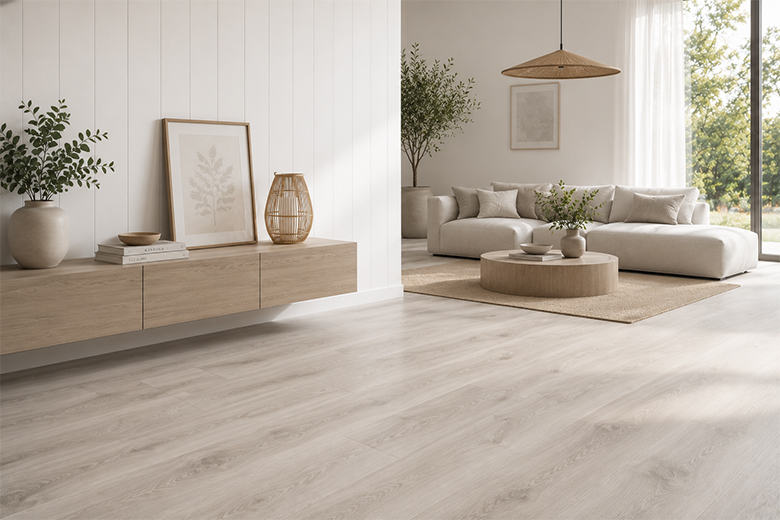
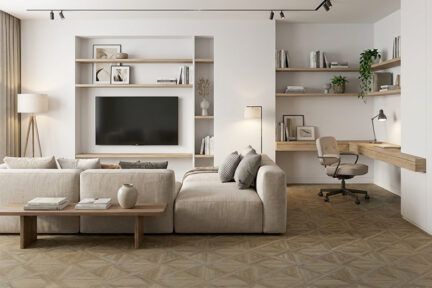
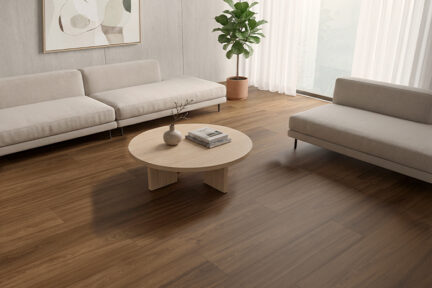


One of the most surprising – and at the same time most valued – aspects of laminate flooring is its ability to change visually throughout the day. Many people notice that the tone of the floor seems to vary depending on the time of day, the amount of natural light coming in or even the type of artificial lighting used in the room. And yes, this is completely normal.
At FAUS INTERNATIONAL FLOORING we want to explain why this effect occurs and how it influences the aesthetic perception of each space.
Light modifies our perception of color
The color we see never depends solely on the material. Lighting plays a fundamental role in how we perceive the tones, textures and shades of any surface, especially in high quality laminate flooring.
The incidence of light can make the same soil:
- Look warmer or cooler.
- Highlight different veins and reliefs.
- Appear lighter during the day and more intense at night.
- Slightly change the shade depending on the orientation of the room.
This happens because the surface of the ground reflects light differently depending on:
- Light intensity.
- The angle of entry of the light.
- The type of lighting (natural, warm LED, cold LED, halogen, etc.).
- The floor finish (matte, synchronized, textured…).
Natural light: a living floor all day long
Natural light is constantly changing. It is not the same in the morning as it is at dusk, nor is it the same in summer as it is in winter. That’s why a laminate floor can offer different visual sensations throughout the day.
For example:
- In morning light, tones tend to look softer and more neutral.
- At midday, the intense lighting highlights details and textures.
- At sunset, warmer and cozier shades appear.
In addition, the orientation of the house also has an influence:
- North-facing rooms receive cooler light.
- Those facing south enjoy a warmer and more intense light.
This means that the same floor model can be perceived slightly differently depending on the space where it is installed.
Artificial lighting also has an influence
Not all artificial lights illuminate equally. The color temperature of the bulbs significantly changes the appearance of the floor.
WARM LIGHT: Brings a cozier feel and enhances honey, beige and brown tones.
NEUTRAL LIGHT: Offers a more balanced and natural color perception.
COLD LIGHT: Tends to emphasize grays and more contemporary tones.
For this reason, in interior design projects it is common to combine the design of the floor with the type of lighting to achieve the desired atmosphere.
Finishes and textures enhance this effect.
In state-of-the-art laminate flooring, such as those developed by FAUS, synchronized textures and realistic finishes interact with light in a much more natural way.
This provides visual depth and a more authentic aesthetic, very similar to natural wood. Grains, knots and reliefs can become more visible depending on how light strikes the surface.
Far from being a defect, this behavior brings dynamism and personality to the space.
One floor, multiple sensations
The ability of a laminate floor to vary visually according to the lighting is precisely one of the characteristics that make it so attractive. The space evolves throughout the day and generates different atmospheres without the need to change any decorative element.
At FAUS INTERNATIONAL FLOORING we design floors designed to offer realism, depth and beauty in any lighting conditions, achieving more natural, elegant and full of life spaces.
Because a great floor is not only walked on. It is also lived… and transformed by the light.